

How To Draw A Sphere With Lines

Setting up the LaTeX document
First nosotros demand to set up up the LaTeX document past using the next code:
\documentclass{standalone} \usepackage{pgfplots} \usepackage{tikz-3dplot} \tdplotsetmaincoords{60}{115} \pgfplotsset{compat=newest} \begin{certificate} \brainstorm{tikzpicture}[] % Here goes the code \end{tikzpicture} \end{certificate} Remember that here we use the standalone every bit documentclass. This document class fits the size of the page to the size of the illustration, but of course you can employ any certificate class.
We need to load the supporting packages pgfplots and tikz-3dplot . It should exist noted that these packages are built on TikZ which means that TikZ is also loaded. In our example we've used \tdplotsetmaincoords{60}{115} to prepare up a desired bending of visualization, you tin put different values to get a different point of view of the 3D drawing.
Describe Lines in 3d coordinates
In one case you accept completed the fix of the document, yous can outset drawing. The most important command in TikZ is \draw[options]. This command is used to describe lines, arrows, circle, and whatsoever basic shape. Depending of the options provided to the draw command, you can get different types of lines like dashed or dotted, and too you can specify the stroke of the line like thin or thick. For instance if you write -stealth in the options you volition get a line with an arrowhead (check this post for more details about TikZ arrows ).
The following code:
\documentclass[edge=0.2cm]{standalone} \usepackage{pgfplots} \usepackage{tikz-3dplot} \tdplotsetmaincoords{60}{115} \pgfplotsset{compat=newest} \begin{document} \begin{tikzpicture}[tdplot_main_coords, calibration = ii.v] % Create a point (P) \coordinate (P) at ({1/sqrt(three)},{i/sqrt(3)},{1/sqrt(3)}); % Projection of the point on 10 and y axes \describe[sparse, dashed] (P) --++ (0,0,{-1/sqrt(3)}); \draw[thin, dashed] ({1/sqrt(3)},{1/sqrt(3)},0) --++ (0,{-1/sqrt(3)},0); \draw[thin, dashed] ({1/sqrt(3)},{1/sqrt(iii)},0) --++ ({-1/sqrt(iii)},0,0); % Axes in 3 d coordinate system \draw[-stealth] (0,0,0) -- (1.80,0,0); \draw[-stealth] (0,0,0) -- (0,ane.30,0); \draw[-stealth] (0,0,0) -- (0,0,i.30); \depict[dashed, grey] (0,0,0) -- (-1,0,0); \draw[dashed, gray] (0,0,0) -- (0,-1,0); % Line from the origin to (P) \describe[thick, -stealth] (0,0,0) -- (P); \end{tikzpicture} \end{document} yields:
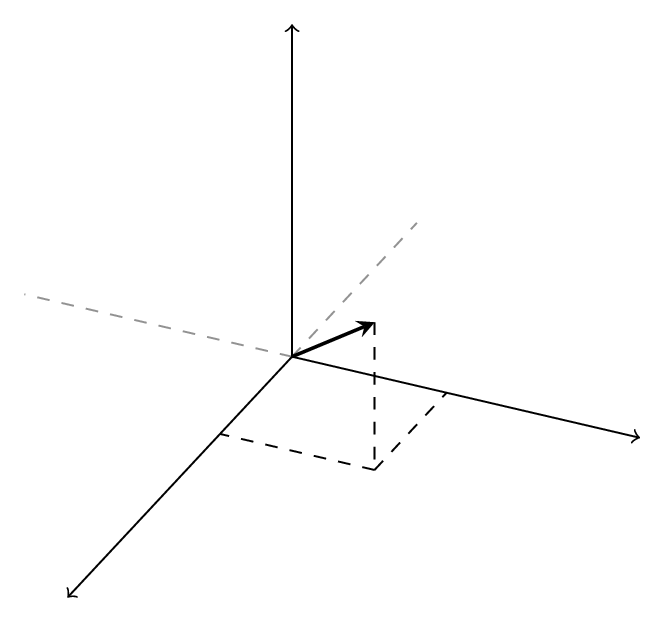
In the previous lawmaking, we use the control \coordinate to ascertain a indicate on the surface of the sphere. We have choosen the point (1/√3,ane/√3,1/√three), which corresponds to a signal on the surface of a sphere of radius 1.
In the options of the tikzpicture environment we need to add tdplot_main_coords in social club to make sure we are using the angles of visualization defined previously. Also we specified the scale of the picture past using the scale command, here nosotros use a factor of 2.v.
Draw an arc in 3d coordinates
The next step is very simple. We have to draw arcs to make a wireframe structure of the sphere. For this purpose we can employ again the \draw command, but besides nosotros have to use the \tdplotsetrotatedcoords{a}{b}{c} control, which allows u.s. to rotate the arcs around the coordinate axes. Here is the corresponding lawmaking:
\documentclass[border=0.2cm]{standalone} \usepackage{pgfplots} \usepackage{tikz-3dplot} \tdplotsetmaincoords{sixty}{115} \pgfplotsset{compat=newest} \begin{certificate} \brainstorm{tikzpicture}[tdplot_main_coords, calibration = 2.5] % Create a point (P) \coordinate (P) at ({1/sqrt(3)},{1/sqrt(3)},{1/sqrt(3)}); % draw arcs \tdplotsetrotatedcoords{0}{0}{0}; \depict[dashed, tdplot_rotated_coords, grey ] (0,0,0) circumvolve (1); \tdplotsetrotatedcoords{ninety}{90}{90}; \draw[dashed, tdplot_rotated_coords, grayness ] (i,0,0) arc (0:180:1); \tdplotsetrotatedcoords{0}{90}{ninety}; \draw[dashed, tdplot_rotated_coords, greyness ] (1,0,0) arc (0:180:1); % Project of the signal on X and y axes \describe[thin, dashed] (P) --++ (0,0,{-1/sqrt(iii)}); \depict[thin, dashed] ({one/sqrt(3)},{1/sqrt(3)},0) --++ (0,{-1/sqrt(3)},0); \describe[thin, dashed] ({1/sqrt(3)},{1/sqrt(3)},0) --++ ({-1/sqrt(3)},0,0); % Axes in iii d coordinate system \draw[-stealth] (0,0,0) -- (one.80,0,0); \describe[-stealth] (0,0,0) -- (0,one.30,0); \draw[-stealth] (0,0,0) -- (0,0,1.30); \depict[dashed, gray] (0,0,0) -- (-1,0,0); \depict[dashed, gray] (0,0,0) -- (0,-i,0); % Line from the origin to (P) \depict[thick, -stealth] (0,0,0) -- (P); \terminate{tikzpicture} \end{document} Check how y'all have to cull the correct angles of rotation to get the desired shapes. This can be confusing at the showtime, simply once yous larn how to utilize information technology correctly is very easy and useful.
Plot sphere in LaTeX
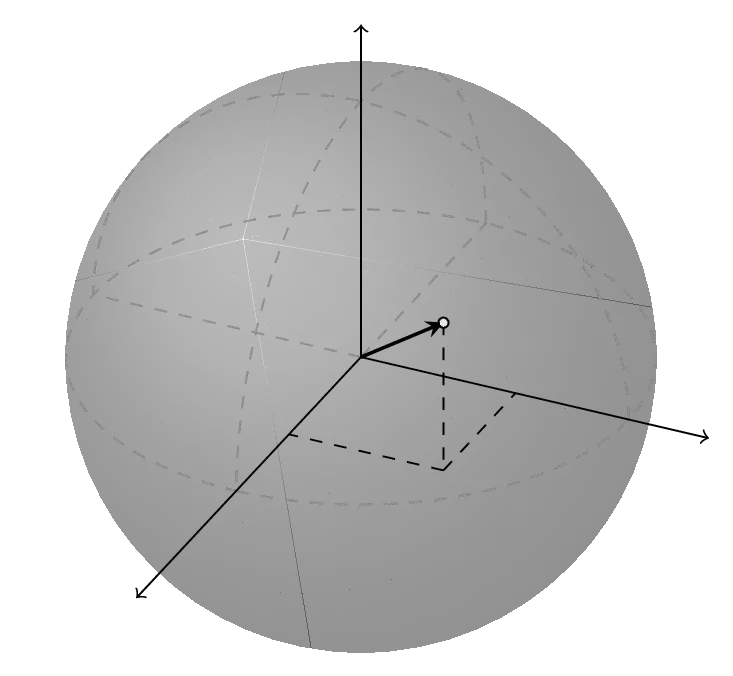
Now it comes the magic. Nosotros take until at present a wireframe sphere, only information technology looks apparently. To make information technology look as a true sphere we tin use a shaded result which is really a play a joke on since nosotros are not plotting whatsoever sphere for existent but a illusion of a sphere. To achieve the event, we can utilize the control \shade as shown beneath:
\documentclass[border=0.2cm]{standalone} \usepackage{pgfplots} \usepackage{tikz-3dplot} \tdplotsetmaincoords{60}{115} \pgfplotsset{compat=newest} \brainstorm{document} \begin{tikzpicture}[tdplot_main_coords, scale = two.5] % Create a point (P) \coordinate (P) at ({1/sqrt(three)},{one/sqrt(3)},{1/sqrt(3)}); % Draw shaded circumvolve \shade[ball color = lightgray, opacity = 0.five ] (0,0,0) circle (1cm); % describe arcs \tdplotsetrotatedcoords{0}{0}{0}; \draw[dashed, tdplot_rotated_coords, gray ] (0,0,0) circle (1); \tdplotsetrotatedcoords{90}{90}{ninety}; \draw[dashed, tdplot_rotated_coords, gray ] (1,0,0) arc (0:180:1); \tdplotsetrotatedcoords{0}{90}{90}; \depict[dashed, tdplot_rotated_coords, gray ] (one,0,0) arc (0:180:1); % Project of the point on X and y axes \draw[sparse, dashed] (P) --++ (0,0,{-ane/sqrt(3)}); \draw[thin, dashed] ({1/sqrt(3)},{one/sqrt(3)},0) --++ (0,{-1/sqrt(3)},0); \depict[thin, dashed] ({1/sqrt(3)},{one/sqrt(3)},0) --++ ({-ane/sqrt(3)},0,0); % Axes in 3 d coordinate organization \draw[-stealth] (0,0,0) -- (1.lxxx,0,0); \draw[-stealth] (0,0,0) -- (0,ane.30,0); \draw[-stealth] (0,0,0) -- (0,0,1.xxx); \draw[dashed, gray] (0,0,0) -- (-1,0,0); \describe[dashed, gray] (0,0,0) -- (0,-1,0); % Line from the origin to (P) \draw[thick, -stealth] (0,0,0) -- (P); % Add small circle at (P) \draw[fill = lightgray!fifty] (P) circle (0.5pt); \finish{tikzpicture} \end{certificate} Compiling this code yields:
Add labels to axes
Finally, to annotate the drawing and locate the labels of axis and points we tin utilize the \node[location] {label} syntax after each coordinate to be annotated. Hither is the final lawmaking:
\documentclass[edge=0.2cm]{standalone} \usepackage{pgfplots} \usepackage{tikz-3dplot} \tdplotsetmaincoords{threescore}{115} \pgfplotsset{compat=newest} \begin{certificate} \begin{tikzpicture}[tdplot_main_coords, scale = ii.v] % Create a betoken (P) \coordinate (P) at ({one/sqrt(3)},{1/sqrt(three)},{1/sqrt(three)}); % Depict shaded circle \shade[ball color = lightgray, opacity = 0.five ] (0,0,0) circumvolve (1cm); % draw arcs \tdplotsetrotatedcoords{0}{0}{0}; \draw[dashed, tdplot_rotated_coords, gray ] (0,0,0) circle (i); \tdplotsetrotatedcoords{ninety}{xc}{90}; \draw[dashed, tdplot_rotated_coords, grayness ] (1,0,0) arc (0:180:1); \tdplotsetrotatedcoords{0}{xc}{90}; \draw[dashed, tdplot_rotated_coords, gray ] (1,0,0) arc (0:180:1); % Projection of the point on X and y axes \depict[thin, dashed] (P) --++ (0,0,{-i/sqrt(3)}); \draw[thin, dashed] ({1/sqrt(3)},{1/sqrt(3)},0) --++ (0,{-1/sqrt(3)},0); \depict[thin, dashed] ({one/sqrt(iii)},{ane/sqrt(3)},0) --++ ({-1/sqrt(3)},0,0); % Axes in 3 d coordinate organisation \depict[-stealth] (0,0,0) -- (1.80,0,0) node[beneath left] {$x$}; \depict[-stealth] (0,0,0) -- (0,1.30,0) node[beneath correct] {$y$}; \draw[-stealth] (0,0,0) -- (0,0,ane.xxx) node[above] {$z$}; \depict[dashed, gray] (0,0,0) -- (-1,0,0); \draw[dashed, gray] (0,0,0) -- (0,-1,0); % Line from the origin to (P) \describe[thick, -stealth] (0,0,0) -- (P) node[right] {$P$}; % Add together small circle at (P) \draw[make full = lightgray!50] (P) circle (0.5pt); \end{tikzpicture} \end{document} 
Source: https://latexdraw.com/draw-a-sphere-in-latex-using-tikz/
Posted by: tatesincom.blogspot.com
0 Response to "How To Draw A Sphere With Lines"
Post a Comment